


Volume #18 | IssueNo. 321/2026 | February 2026
Power of Silence
We are living in a world of uncertainty, mayhem, destruction, death, debris, agony, grief and numbness of emotions. While we need to be careful, cautious and caring for each other, it is also time for an open-minded invitation to wisdom, positivity, and enlightenment from all over the world. “Let noble thoughts come to me from all directions”- Ā no bhadrāḥ kratavo yantu viśvataḥ as the Rig Veda says.
Sharing the essence of a powerful talk on “SILENCE” by a renowned spiritual guru, that I had the privilege to listen to recently:
- Om Purnamadah Purnamidam : A famous Upanishadic peace mantra which means that everything is, at its core, perfect and complete, as it originates from a perfect source, encouraging a sense of peace and wholeness.
Completeness equated with silence which is wholesome and perfect. Origin of silence is from completeness, fullness. Nothing left to speak. So silence. This world is complete, but we may not agree. We are always competing and trying to complete something. Instead turn inwards. - Original thoughts come from silence. Rest is copied.
- Whole spirit of Upanishad is global. Loka samasta…. embrace entire world. Have a global mindset.
- We can listen only when the mind is silent. Not chattering.
- Silence is not stopping from speaking. It is pausing / reflecting before speaking. Success comes when there is silence before action.
- The Kena Upanishad explores the ultimate reality (brahman) by asking “by whom” (kena) the mind and senses are directed. It teaches that brahman is realized through intellectual reflection and humility.
Supreme reality is something that words cannot be explained. Must be experienced and reflected upon in silence. Silence is the basis for words and action – go into self-retreat. - Mind cannot keep up with what appears and disappears as thoughts. Find a gap between successive thoughts through quiet witnessing or Sakshi bhava. Silence is this secure place. To observe keenly get rid of prejudices. Observe things as they are. Slowly disengage. Clarity inside brings clarity outside.
- Embryo inside a womb is in silence until it lets out its first cry on entering the world. The womb period is powerful for absorption of knowledge.
- Mouna vrat is more for the mind and not just for speech alone.
- Yogaś citta-vṛtti-nirodhaḥ : Pathanjali says through yoga distractions settle down. Mind becomes calm and silent.
- Hermetic vacuum in Greek mythology : paradoxical idea of a space totally cut off from the world with no influence in or out – “airtight” metaphysically.
Greatest discovery happens in vacuum. Mind refuses to live in a vacuum. Refuses not to be engaged. How to do it ? Watch the breath. You can control your thoughts through breath change. - “No-thing” vs. Nothing:Shunya is not a state of total absence or nothingness, but rather “no-thingness” which cannot be defined. It is described as the root of all existence. Silence is represented by Shunya.
- Silence is a strategic asset for a leader which helps develop a spirit that is manifested in action for global life.
Disclaimer : this is the essence of the talk as understood by me and not an exact reproduction. I have tried my best to present it as close to what the learned speaker said or meant, within my limited assimilation and understanding.
Try to absorb in silence the Power of Silence. As you move on to this 321st issue of Samhita, you will find a variety of regulatory updates from across ministries and regulators. Highlight is the Startup hero story, attractively created by our team member Ms. Anjali Bhat.
For any previous issues of Samhita and the readers’ feedback, please visit http://www.sharadasc.com/resource-center/.
Happy Reading
S.C. Sharada
 www.linkedin.com
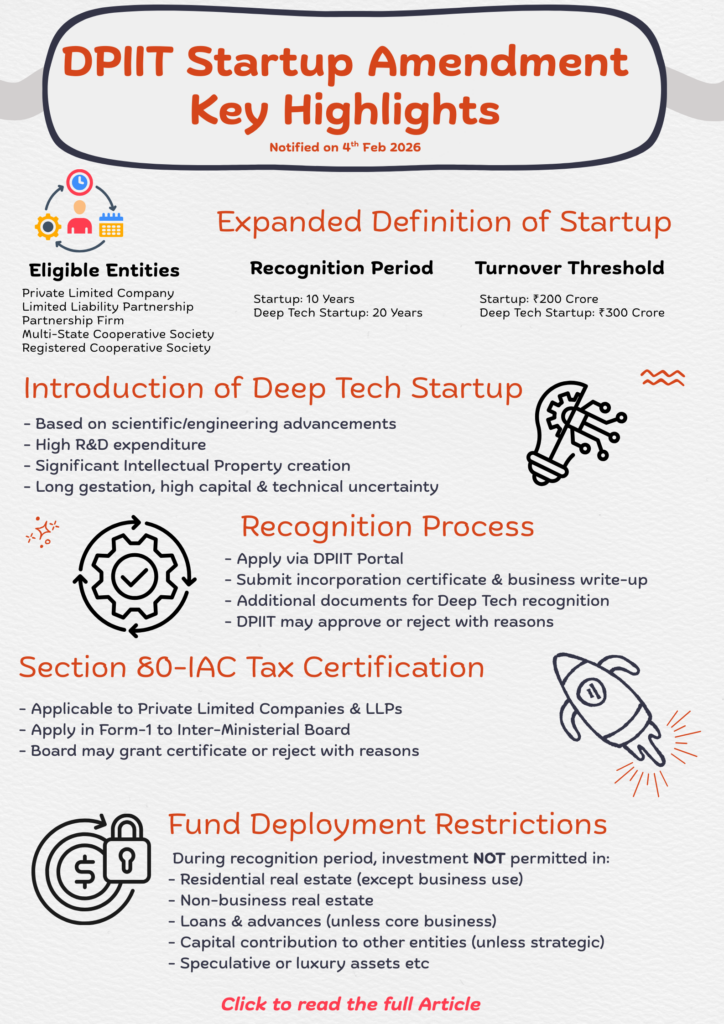
Revised norms for DPIIT Startup Registration
Regulatory Updates
MCA Update
Several companies, including MSMEs and private companies, have not been able to complete their annual compliances in time, leading to a situation of additional financial burden on account of additional fees of Rs. 100/- payable due to delay. The Ministry received a representation in this regard with a request to waive off additional fees. Pursuant to the representations, MCA vide Circular dated February 24, 2026 has introduced the “Companies Compliance Facilitation Scheme, 2026 (CCFS-2026)”.
One Time Opportunity : This scheme offers a one-time cost-saving opportunity to allow companies to file their pending documents related to Annual Return and Financial Statements or to file for dormancy/closure by payment of lesser fees.
Validity of the Scheme: The Scheme shall be in force from April 15, 2026 to July 15, 2026
Eligible Companies: All Companies are eligible to avail the scheme, except the following:
- Companies against which final notice for striking off the name u/s 248 of the Act has already been issued by the Registrar
- Companies which have filed an application for striking off
- Companies which have filed an application for obtaining dormant status u/s 455 of the Act before the commencement of this scheme
- Companies which have been dissolved pursuant to a scheme of amalgamation under the Act
- Vanishing companies
Relevant e-forms covered under the Scheme: Eligible companies may file one or more of the following e-forms under the Scheme:
- Form MGT-7, MGT-7A, AOC-4 (including AOC-4 CFS, NBFC (Ind AS), AOC-4 CFS NBFC (Ind AS), AOC-4 XBRL), ADT-1, FC-3, and FC-4 and the corresponding forms prescribed under the erstwhile Companies Act,1956.
Manner of payment: Under this scheme, eligible companies/inactive companies have an option to:
- file pending annual returns and filings by paying only 10% of the total additional fees payable;
- file application in Form MSC-1 for obtaining “dormant company” status upon payment of one-half of the normal fees prescribed in the Companies Act; or
- file an application in Form STK-2 to get the company struck-off, by paying 25% of the filing fee
Immunity from penal action: No penalty shall be levied for the filings made under this scheme as long as the Company has completed the filings prior to receiving of notice by adjudicating officer or within 30 days from issuance of the notice by the adjudicating officer.
Where the filings are made after expiry of period of 30 days from issuance of notice or where the adjudication order imposing the penalty has been issued, no immunity is available for the filings made under the scheme.
Post July 15, 2026 the Registrars of Companies is empowered to take actions against those Companies who have not availed the Scheme and continue to be in default w.r.t forms covered under the Scheme.
RBI Updates
Pursuant to the feedback received for draft amendment to Foreign Exchange Management (Borrowing and Lending) Regulations, 2018, the RBI vide notification dated February 16, 2026 has notified the Foreign Exchange Management (Borrowing and Lending) (First Amendment) Regulations, 2026.
Common set of regulations for ECB in Foreign Currency or INR, expanded eligible borrower and recognized lender categories, removal of criteria for individual to be a shareholder to be a lender, introduction of borrowing limits and certain flexibility in end use are some of the major highlights of the amended regulations.
To read the highlights, refer the link below.
(Open Highlights new ECB Framework)
(Open RBI Notification dt February 16, 2026)
Pursuant to the revised ECB framework under the Foreign Exchange Management (Borrowing and Lending) (First Amendment) Regulations, 2026 dated February 09, 2026, the forms pertaining to ECB, prescribed under the Master Direction on Reporting under FEMA have been modified. As per RBI Circular dated February 18, 2026, the Form ECB 1/Revised Form ECB 1 and Form ECB 2 as per Annex I and Annex II of the said Circular shall be applicable with immediate effect.
SEBI Updates
To promote Ease of Doing Investment and Ease of Doing Business, SEBI has issued a circular dated January 30, 2026, effective from April 02, 2026, simplifying investor services by removing physical processes and enabling direct dematerialisation of securities. Highlights of the Circular are as below:
- Requirement for issuing a Letter of Confirmation (LOC) for investor service requests (duplicate certificates, transmission, transposition, unclaimed suspense accounts, etc.) has been done away with.
- Direct credit of securities into the investor’s demat account will now replace the earlier LOC-based process.
- RTAs/listed companies must verify documents and directly credit securities into the demat account of the investor after due diligence.
- Investors must attach a latest Client Master List (CML) (not older than 2 months, attested by DP) with their service request.
- Depositories must create a system/process enabling direct credit by RTAs/companies.
- Several paragraphs and annexures of the Master Circular (June 23, 2025) have been amended to reflect the direct-credit process.
- Any LOC already issued before April 2, 2026 can still be submitted for dematerialisation within 120 days of its issue.
- Physical certificates, where required, will be retained and defaced with the stamp “Securities issued in dematerialised form.”
- In transmission cases, securities must be directly credited to the claimant’s demat account within 30 days.
- Updated formats for Affidavit-cum-Indemnity and ISR-4 have been prescribed; few old formats (including Annexure-7 LOC format) are deleted.
This enhances investor convenience and reducing risks associated with handling physical documents.
SEBI vide circular dated February 26, 2026 has introduced new disclosure requirements to help investors clearly identify registered market participants on social media. The aim is to promote transparency, prevent misleading content, and enhance investor protection in an environment where social media is widely used for investment-related information. The circular is effective from May 01, 2026 and highlights are follows:
- All SEBI-regulated entities and their agents must display their registered name and SEBI registration number on their social media homepages and at the beginning of every securities-related post or video.
- Entities with multiple registrations must provide a web link showing all their SEBI registrations, and each post must show the relevant registration.
- Agents must disclose their principal entity’s registration number, along with their own details, at the beginning of each post.
- The rule applies to all platforms, such as YouTube, Instagram, X, WhatsApp, LinkedIn, Telegram, etc.
NSE vide circular dt February 20, 2026 has expanded the Single Filing System (API-based integration between stock exchanges) to include additional XBRL disclosures under Regulation 30 of the SEBI LODR. Effective February 21, 2026, listed entities can now use a single XBRL filing for the following events instead of filing separately with NSE and BSE:
- Fraud / Default / Arrest disclosures
- Corporate Debt Restructuring
- Resolution Plans, including Inter-Creditor Agreements (ICA) and One-Time Settlements (OTS)
- Issue Summary Document (ISD) for buybacks (open & tender route)
BSE vide circular dated February 23, 2026 has updated the criteria for companies seeking direct Main Board listing by introducing an alternate eligibility route, allowing companies with ₹100 crore revenue in each of the last 3 financial years to qualify even if they do not meet market‑cap or liquidity norms. It has also relaxed promoter holding and lock‑in requirements for companies already listed on recognised stock exchanges. The revised norms apply from March 01, 2026.
IFSCA Updates
The IFSCA vide Circular dated February 03, 2026 has mandated that all Finance Companies and Finance Units operating in the IFSC and serving clients outside their own group must maintain a dedicated website or webpage to enhance transparency and consumer awareness. The site must display key information, including an overview of the GIFT IFSC ecosystem, the entity’s Certificate of Registration with its permitted activities, detailed descriptions of products and services offered, grievance-redressal procedures with contact details, and the names and contact information of key managerial personnel. The requirement will come into effect from April 01, 2026.
To strengthen the regulatory ecosystem and promote ease of doing business within the IFSC, IFSCA vide Circular dated February 06, 2026 has issued directions mandating a unified approach for obtaining ISINs for dematerialised securities and permitted financial products. Key highlights include:
- All IFSC Units must obtain ISINs only from a depository recognised by IFSCA for dematerialising securities or permitted financial products.
- Units currently using ISINs issued by domestic Indian depositories must shift to new ISINs issued by an IFSC-recognised depository by August 31, 2026.
- Issuers may still use international central securities depositories for issuance and listing of debt securities and other permitted products as allowed under IFSC regulations.
- Recognised IFSC depositories must:
- Prepare a standardised process flow in coordination with domestic depositories in India for seamless onboarding.
- Issue FAQs and notices to guide IFSC Units for smooth transition.
- The recognised depository must submit a transition completion report to IFSCA by September 30, 2026.
IBBI Update
IBBI vide notification dated February 25, 2026 has amended the IBBI (Insolvency Resolution Process for Corporate Persons) (“CIRP”) Regulations, 2016. The amendments include modifications to definition of fair value, the process of determining fair value and liquidation value and submission of information memorandum etc., Highlights of the amendments are as follows:
Revised definition: “fair value” means the estimated realizable value of the corporate debtor or the assets of the corporate debtor, as the case may be, if they were to be exchanged on the insolvency commencement date between a willing buyer and a willing seller in an arm’s length transaction, after proper marketing, and where the parties had acted knowledgeably, prudently, and without compulsion.
Explanation.- The estimated realizable value of the corporate debtor shall be computed after taking into account the total estimated realizable value of all the assets of the corporate debtor including but not limited to tangible and intangible assets, along-with their underlying synergies.”
Regulation 27 amended: to provide that the resolution professional shall within 7 days of his appointment and not later than 47th day from the insolvency commencement date appoint two sets of registered valuers to determine the fair value and liquidation value in accordance with regulation 35, replacing the earlier requirement of appointing two registered valuers.
Regulation 35 defines each set as a team of registered valuers, one valuer for each asset class of the corporate debtor, with one of them designated as a coordinating valuer for that set
Regulation 35 substituted: inter alia, to provide for the appointment of a third set of registered valuers to submit an estimate of the fair value and the liquidation value in cases where:
- the two estimates of fair value of the corporate debtor or liquidation value are significantly different, or
- the committee proposes to appoint a third set of registered valuers for reasons to be recorded in writing;
ESG Updates
The Ministry of Environment, Forest and Climate Change has notified the Solid Waste Management (SWM) Rules, 2026 on January 27, 2026 under the Environment (Protection) Act, 1986. It shall be effective from April 01, 2026 and replaces the 2016 rules. Highlights of the Rules are as follows:
- The principles of circular economy, extended producer responsibility and the “Polluter Pays” principle are well embedded in these rules.
- The rules provide for environmental compensation for non-compliance, with the CPCB issuing guidelines and State Pollution Control Boards/Pollution Control Committees enforcing penalties.
- Mandatory four-stream segregation at source has been introduced—wet, dry, sanitary and special care waste—with clear pathways for composting, recycling, authorised handling and safe disposal.
- The rules clearly define Bulk Waste Generators based on area, water use or waste generation thresholds and introduce Extended Bulk Waste Generator Responsibility, requiring on-site processing of wet waste or certification where this is not feasible.
- To strengthen infrastructure and monitoring, graded norms for land allocation and buffer zones for waste facilities have been prescribed, alongside a centralised online portal for end-to-end tracking, registration, reporting and audits of waste processing facilities, including legacy waste remediation.
- Local bodies are responsible for collection, segregation and transportation of waste in coordination with formally recognised Material Recovery Facilities, with encouragement to generate carbon credits and special focus on peri-urban rural areas.
- The rules mandate increased use of Refuse Derived Fuel by industries, restrict landfilling to inert and non-recoverable waste with higher fees for unsegregated waste, and require annual landfill audits and time-bound biomining of legacy dumpsites.
- Special provisions address waste management in hilly areas and islands, including tourist user fees and decentralised processing by hotels, while Central and State-level committees have been constituted to ensure effective implementation.
(Open Press Release dt January 28, 2026)
(Open Notification dt January 27, 2026)
India’s Union Budget 2026 placed a strong emphasis on climate action, with a major ₹20,000 crore ($2.2 billion) commitment over five years to scale up carbon capture, utilization and storage (CCUS) technologies. The goal is to move CCUS from pilot projects to large scale industrial use across hard to decarbonize sectors such as power, steel, cement, refineries and chemicals. The budget also highlighted transport decarbonization, introducing measures to cut emissions in logistics and passenger mobility. Clean energy manufacturing received a boost through extended customs duty exemptions, and critical minerals were recognized as a strategic priority with duty relief for mineral processing equipment.
DGFT Update
DGFT vide Trade Notices dated February 20, 2026 has issued various Guidelines that are intended to provide full fledged ecosystem support for export oriented MSMEs. The Guidelines issued include:
- Support for Alternative Trade Instruments under Export Promotion Mission (EPM)- to reduce dependence on traditional forms of finance, reduce cost of funds through interest subvention and Export Factoring in initial stages has been permitted subject to certain conditions.
- Trade Regulations, Accreditation and Compliance Enablement (TRACE) under EPM– to strengthen quality and technical compliance ecosystem and help MSMEs meet international standard requirements. Partial reimbursement of compliance‑related expenses such as Testing, Auditing, Traceability systems etc.
- Integrated Support for Trade Intelligence and Facilitation (INSIGHT) under EPM- to improve export preparedness and build export capacity, training programs, cluster level outreach, digitally aided decision-making systems will be rolled out.
- Facilitating Logistics, Overseas Warehousing and Fulfilment (FLOW) under EPM- to mitigate logistics-related constraints faced by MSMEs in accessing overseas markets, assistance for warehousing, fulfilment centres, market-facing infrastructure that facilitates delivery and distribution in foreign markets will be provided.
- Facilitating Logistics Interventions for Freight and Transport (LIFT) under EPM- to address geographical disadvantages and logistics gaps affecting MSMEs in low export intensity areas, the guidelines mention about assistance in the form of lowered freight and logistics costs for certain notified products such as spices, fruits, bamboo products, textiles, handicrafts, millets etc
All the 5 schemes are effective immediately and will operate on a pilot basis. For continuous refinement, a feedback driver approach has been adopted.
GST Update
GST Department has released an advisory on February 19, 2026 w.r.t Interest computation and other enhancements in GSTR-3B. Highlights of the same are as follows:
Interest on delayed tax payment: Auto-calculated in Table 5.1 based on minimum cash balance in Electronic Cash Ledger from due date till payment (per proviso to Rule 88B(1)).
Formula: Interest only on (Net liability – min ECL balance during delay). Auto-filled amount is the minimum — cannot be reduced, but can be increased.
Prior-period supplies: Tax liability breakup table auto-populated based on document dates; suggestive only (can increase, not decrease).
IGST payment flexibility: From February 2026 tax period: After exhausting IGST ITC, use CGST or SGST ITC in any order for IGST liability.
Cancelled registrations: Interest on delayed final return now collected via GSTR-10.

Quote of the day
Lokah Samastah Sukhino Bhavantu (लोकः समस्ताः सुखिनो भवन्तु) : May everyone in the whole world be happy.
Disclaimer: The contents of this Newsletter are only a summary and has not dealt with any issue in detail. Any action taken or proposed to be taken must be in consultation with professionals and not merely based on the articles / news updates. S. C. Sharada & Associates disclaims all liability on action taken without professional advice.