



Volume #18 | IssueNo. 322/2026 | March 2026
Unreduced, Unstoppable
“I can be changed by what happens to me. But I refuse to be reduced by it.” — Maya Angelou
What better inspiring thought to begin the International Women’s Day issue of Samhita than this, by the legendary Maya Angelou. As I reflect on the month gone by – March 2026 – I feel so fortunate to have interacted (observed) with some amazing women who define this very statement.
- Nelamma from Mysore, a 70+ year old woman grave digger

since 2005-ensuring every single day the graves she digs give a dignified, safe and graceful haven to the human body. I was felicitated along with her as a woman achiever by a Foundation recently where the awardees spoke. She chose to smile and just say a few words on stage though her YouTube conversations are very eloquent. She buries 3-4 bodies a day at very nominal charges and lives with her family in the graveyard with snakes, peacocks, monkeys, trees and tombstones for company. There is an earthy wisdom that comes from her life experiences. Pride that comes from the joy of her occupation. To me she personifies “The most effective way to do it, is to do it.” — Amelia Earhart. - During a 1 to 1 women startup mentoring program, I saw a young mother from a Tier 2 city on screen, profusely apologizing for joining a bit late to the session. With an infant resting on her hand, sleeping blissfully, she deftly opened the laptop with the other and made a beautiful presentation about her startup business. I was already impressed by her commitment to pursue her startup and attend the mentoring session with no personal excuses. As the slides moved on, it unraveled this young mother’s grit, hope, risk-taking ability, and never-say-die attitude – she had built a special purpose chair for her first born who was diagnosed with a rare kind of neurological condition that limited his movements. She had turned it into a furniture business for the special-needs children and was seeking some legal advice from me. I was dumbfounded by her zeal and enthusiasm that defied her present condition. She stood for “Turn every adversity into an opportunity.”
- Picture this: A young lady driving an electric autorickshaw with an infant in one hand. As I was stepping out to attend a Women’s Day event, I saw this EV whizz past me that left me wondering if it was a real or an AI moment! While one may argue that this is not safe for her, her baby and the passengers, it left me thinking – what choice does this mother have if she must earn her living and take care of her baby? Does her financial and family condition allow her to hire a house-help or drop the baby at a day-care centre or Anganwadi? What drove her to do this? I truly wished this was a long, red-signal Bengaluru traffic moment where I could have asked her all these questions 😊
- At the Vonisha (https://www.vonishafoundation.org/)
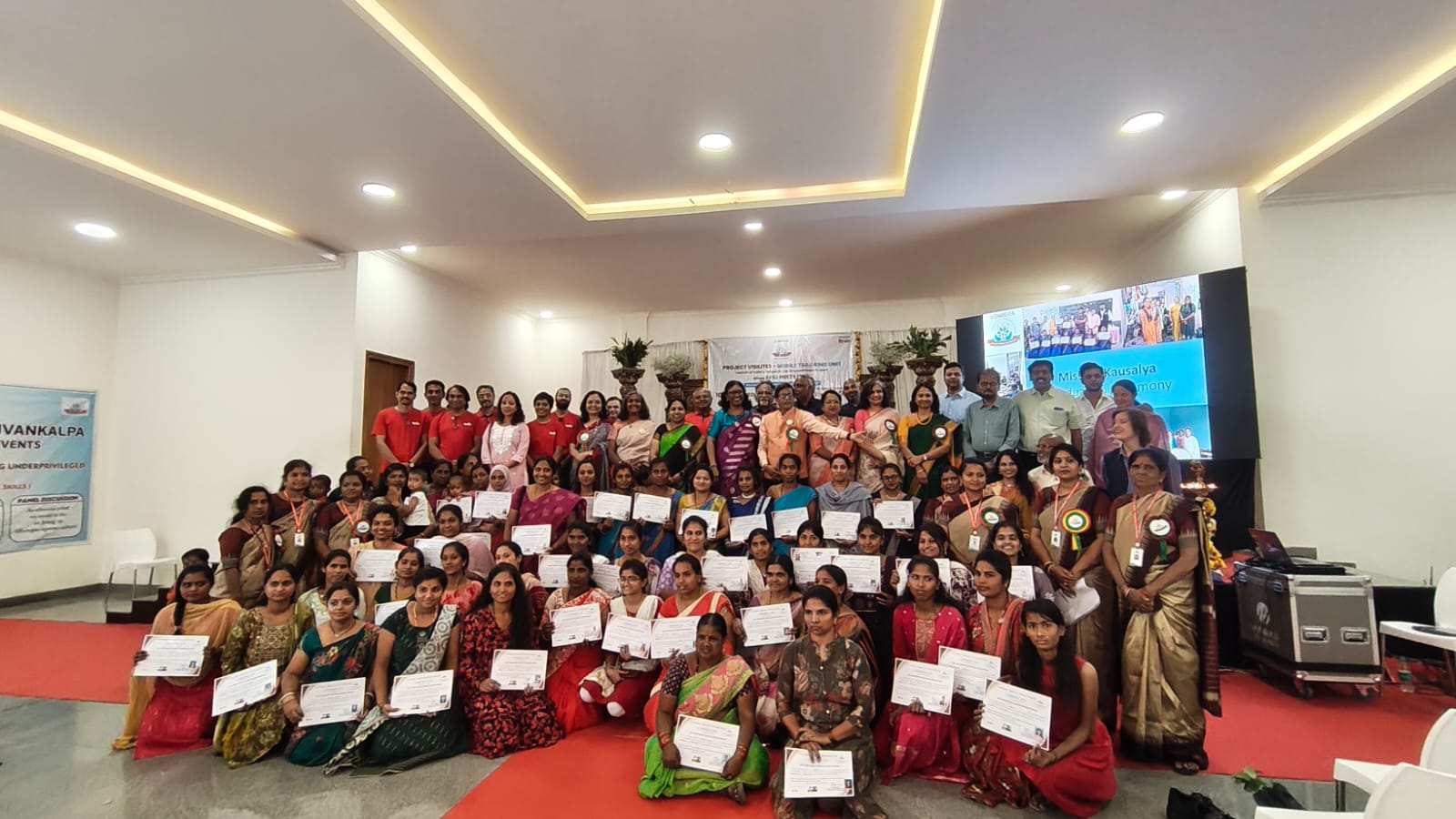
Women Empowerment Programme Graduation Ceremony, I was greeted by a large number of happy women of all ages, proudly displaying their tailoring and embroidery products. They beamed with pride and self-esteem as they shared their joy about skilling, financial independence, teaching, leading their own units and above all building a network of empowered women. They enjoyed their freedom, made new sakhis (friends) and shared their problems, finding a new identify beyond their kitchens! Who knows any of them could turn an Estée Lauder who said “I never dreamed about success. I worked for it.”
I am sure each of you can think of the amazing women from your everyday lives that make each day a Women’s Day! The 322nd issue of Samhita is also put together by a bunch of spirited women (men included😊) with updates from MCA, IBBI, RBI, DGFT, GST, IT, SEBI etc. This issue also carries Annual Compliance Calendar for FY26-27.
For any previous issues of Samhita and the readers’ feedback, please visit http://www.sharadasc.com/resource-center/.
Others
Press Note 3 of 2020 restricted investments from countries sharing land border with India. Government approval is required for investments by an entity of a country that shares land border with India or where the beneficial owner of an investment is a citizen of such country. Further, if such entity or citizen is from Pakistan, investment with Government approval is allowed in sectors other than Defence, Space, Atomic energy and other prohibited sectors. Government approval is also required for any subsequent change in ownership resulting in beneficial ownership falling within the restricted nations.
On March 10, 2026 the Cabinet approved changes in these guidelines to provide for definitive timelines for approval of such restricted investments, unlock greater FDI towards deeptech, manufacturing in electronic components, capital goods and solar cells etc. As per the GOI’s Press Release, investments in specified sectors/activities of manufacturing in capital goods, electronic capital goods, electronic components, polysilicon and ingot-wafer, shall be processed and decided within 60 days.
Further, vide Press Note 2 (2026) dated March 13, 2026 the Government of India has amended Para 3.1.1 of the FDI Policy Circular of 2020 dated 15.10.2020.
The revised framework significantly strengthens the earlier regime by providing much-needed clarity on the concept of “beneficial ownership.” While the earlier Press Note mandated Government approval for investments from countries sharing land borders with India (or where the beneficial owner was situated in such countries), it did not clearly define how beneficial ownership was to be determined.
The present update addresses this gap by expressly linking the concept to the definition under the Prevention of Money Laundering Act, 2002 and the thresholds prescribed under Rule 9(3) of the PML Rules. Further, the scope has been expanded beyond mere ownership through shares. It includes tests of “control” and “ultimate effective control,” through contracts or other arrangements, thereby capturing a wider range of investment structures, including layered and indirect holdings. These tests shall be applied at the level of investor entity.
Another key change is the introduction of a structured compliance and reporting mechanism. Unlike earlier, even those investments that don’t require approval but have any ownership links to countries sharing a land border with India, shall be reported in accordance with DPIIT’s Standard Operating Procedures.
This marks a shift towards enhanced transparency and regulatory oversight, ensuring that even non-controlling or below-threshold investments with potential linkages to land-border countries are monitored more closely, while simultaneously aligning the FDI framework with anti-money laundering standards.
The relevant FEMA Regulations are yet to be updated in light of the above and hence not yet effective.
(Open GOI Press Release dt March 10, 2026)
(Open Press Note 2 of 2026 dt March 13, 2026)
MCA Updates
In continuation of notification dated December 31, 2025 wherein the cycle for KYC was changed from annual to once in three years, the MCA has issued certain clarifications. Highlights of the same are as follows:
- Any pending DIR-3 KYC web or DIR-3 KYC Eforms currently in ‘Draft/pending’ or ‘Pending for DSC upload and payment’ status would be marked under ‘Cancelled’ status and stakeholders are requested to file new DIR-3 KYC web form effective from March 31, 2026.
- Illustrative Scenarios:
- Where a DIN is allotted during the FY 2025-26, Form DIR-3 KYC web shall be due from April 2029 to June 2029, and thereafter every third financial year.
- Where a Director has already filed DIR-3 KYC Eform /DIR-3 KYC Web for the FY 2025-26 i.e. where DIN allotment date is on or before 31 March 2025, the first KYC filing in such case shall be due from April 2028 to June 2028 unless there is any change in KYC particulars.
- A DIN is allotted on 1 January 2026 (i.e., during FY 2025–26). The director later updates their mobile number, email ID, or address in FY 2027–28 using DIR‑3 KYC Web. Even after this update, the three‑year KYC cycle will still be based on the year in which the DIN was allotted (FY 2025–26). So, the next DIR‑3 KYC Web filing will be due April–June 2029. Updates do not reset the cycle.
Rule 8 of the Companies (Incorporation) Rules, 2014 and Rule 18 of the LLP Rules, 2009 contain provisions for reservation of name of companies and LLPs respectively. The MCA has issued detailed advisory on March 12, 2026 and March 25, 2026 emphasizing compliance of various aspects of these rules. Highlights of the same are as follows:
- Names that closely resemble phonetically or otherwise, with any existing or well-known names will not be approved even with NOC. Eg: Avon Engineering Private Limited and Avon Engineers Private Limited, Advik Constructions LLP and Adhvik Constructions LLP.
- Clarity on timelines for reserving names that belong to companies/LLPs that were dissolved, struck off, under liquidation etc – 2 to 20 years.
- In-principle approval from regulator concerned to be provided where the name includes Bank, Insurance, Architect. However, usage of words Architect/Architecture in the Objects clause alone will not require such approval.
- Proof of significance of business relations such as MOU or any other document shall be provided where the name includes name of any foreign country or any city in a foreign country.
- Name reservation shall not be allowed for LLPs where the NIC code and objects relates to activities related to loans and advances, acquisition of shares and securities issued by Government or local authority or other marketable securities of a like nature, leasing, hire -purchase, insurance business, chit business, are of the nature of NBFC/ Investment/ Financial, /Micro finance activities.
- NOC from holder of Registered Trademark shall bear the DSC of the holder
- Requests for withdrawal of reserved name due to change in decisions on business structure from LLP to Company or vice-versa will not be allowed.
The latest Advisory clarifies that only Word Marks require NOC and that the PAN of the holder of TM is not required. Further, the term “Advocate” has been added in the list of professional terms apart from CA/CS/CMA that require In-principle approval from the Council governing such profession.
(Open MCA Advisory dt March 12, 2026)
(Open MCA Advisory dt March 25, 2026)
RBI Update
RBI on March 25, 2026 has released two FAQs pertaining to filing of Annual Return on Foreign Liabilities and Assets (FLA) under FEMA, 1999. Highlights are as follows:
- Covers SEBI registered Alternative Investment Funds (AIFs) having FDI/ODI under entities required to submit FLA return
- Applicable AIFs shall file their FLA in excel format by emailing to FLA team instead of the web based reporting
- OTP sent to authorized person’s email ID shall be valid for 5 minutes instead of 15 minutes
- W.r.t Sales, it is only the Revenue from Operation that shall be included.
- Variation on account of change in accounting standard may be ignored
- Clarifies that entities registered in IFSCA, GIFT City shall file FLA return if they have received foreign investment or hold overseas investments
- NIC 2025 shall be used instead of NIC-2008
- Clarification on payment of Late Submission Fee through the jurisdictional Foreign Exchange Department (FED) of Regional Office of the RBI
(Open RBI FAQs on FLA dt March 25, 2026)
(Open RBI FAQs on FLAIR Portal dt March 25, 2026)
SEBI Updates
SEBI vide circular dated March 04, 2026 has revised the regulatory reporting requirements for Alternative Investment Funds (AIFs), with the objective of improving ease of doing business while maintaining effective supervision. Highlights of the same are as follows:
Shift to Annual Reporting with limited quarterly reports
- AIFs will now be required to submit a Comprehensive Annual Activity Report along with limited quarterly activity reports except for quarter ended March.
- The Annual Activity Report must be filed within 30 days from the end of March for each financial year.
- First Annual Report shall be submitted by May 31, 2026 for FY ending March 31, 2026.
Limited Quarterly Reporting Introduced
- Limited Quarterly Activity Report will be required to be submitted.
- This report must be filed within 15 days from the end of each quarter (except March).
- No separate quarterly report for March, as the annual report will cover these data points.
- First quarterly report under the new format for the Quarter ending June 2026.
Revised Reporting Formats
- Reporting formats have been updated to align with recent amendments to AIF Regulations and SEBI circulars.
- Revised formats will be published by IVCA (Indian Venture and Alternate Capital Association) within 3 days of the circular issuance.
Mode of Submission
All reports (annual and quarterly) must be submitted online via the SEBI Intermediary Portal (SI Portal)
Role of IVCA
IVCA will assist AIFs in:
- Understanding revised reporting requirements
- Addressing implementation challenges
- Ensuring accurate and timely compliance
SEBI has issued two circulars dated March 25, 2026, clarifying that members of the Institute of Cost Accountants of India (ICMAI) are now eligible, in addition to members of ICAI and ICSI, to conduct annual compliance audits of Research Analysts (RAs) and Investment Advisers (IAs). Accordingly, the relevant provisions of the SEBI Master Circulars for RAs and IAs have been amended to permit ICMAI members to undertake these audits within 6 months from the end of the financial year. The compliance audit report (including adverse findings and actions taken) shall be submitted to the respective supervisory bodies within the prescribed timelines, i.e. by October 31 each year. SEBI has also clarified that the annual certificate on client-level segregation of funds for IAs may similarly be obtained from ICAI, ICSI, or ICMAI members. These amendments are applicable with immediate effect and aim to broaden the pool of eligible professionals while maintaining regulatory oversight and investor protection.
(Open SEBI Circular dt March 25, 2026 for Annual Audit of IAs)
(Open SEBI Circular dt March 25, 2026 for Annual Audit of RAs)
In continuation to NSE circular dated September 30, 2024, with respect to single filing system through API-based integration between Stock Exchanges, NSE has extended the same to cover additional disclosures under SEBI (LODR) Regulations. Effective March 07, 2026, the disclosures pertaining to prior intimation for Board meetings under Regulation 29 of SEBI LODR and closure of trading window under PIT Regulations have been enabled in the system.
IFSCA Updates
The IFSCA has issued a circular dated March 19, 2026, effective immediately, to operationalise the Government of India’s pilot scheme under the Export Promotion Mission (EPM–Niryat Protsahan). The scheme seeks to strengthen export financing for MSMEs participating in international value chains by promoting the use of alternative trade finance instruments, with a focus on export factoring. Key highlights are as below:
- The scheme is introduced pursuant to DGFT Trade Notice No. 25/2025-26 dated February 20, 2026, along with detailed policy and operational guidelines
- The objective is to improve access to export finance for MSMEs, particularly those engaged in cross-border trade and global value chains
- Export factoring arrangements, both recourse and non-recourse, denominated in INR or freely convertible foreign currencies, are eligible under the scheme
- Eligible transactions must be entered into between MSME exporters and RBI-regulated or IFSCA-regulated entities
- IFSC Banking Units (IBUs) and Finance Companies/Units (FC/FUs) undertaking factoring activities are required to extend scheme benefits to eligible MSMEs
- The benefit will be provided in the form of interest subvention or equivalent cost support on the export factoring interest component
- Eligible financial institutions must comply with all operational, reporting, claim submission, and timeline requirements as prescribed under the scheme and as updated from time to time
IFSCA, through its circular dated March 10, 2026, has amended its Cyber Security and Cyber Resilience Guidelines to ease compliance for certain regulated entities facing implementation challenges. The amendment grants a 3 year exemption from detailed cyber-security requirements to specified categories, including branches of regulated Indian or foreign entities, Global In-House Centres, entities with fewer than 10 employees, foreign universities in IFSCs, newly incorporated standalone IFSC entities, and credit rating agencies.
During the exemption period, such entities must adopt group-level cyber security frameworks where applicable and submit annual certifications and audit reports to IFSCA confirming that proportionate cyber security measures are in place. The amended provisions are effective immediately.
IBBI Update
IBBI vide circular dated March 06, 2026 has notified the introduction of electronic forms to monitor Insolvency resolution processes of Personal Guarantors to Corporate Debtors under the Insolvency and Bankruptcy Code, 2016 (code). Prior to the introduction of this circular, the Resolution Professionals (RPs) were required to submit periodic updates on the insolvency resolution processes.
To streamline the process and ease the compliance burden for Insolvency Professionals (IPs), IBBI has introduced a set of standardized electronic forms to facilitate systematic and transparent record-keeping and facilitate seamless reporting. All forms are required to be filed on or before the 10th day of the subsequent month after the relevant event. The complete list of forms along with their formats are available in the said circular. The circular, inter alia, provides that:
- Forms shall be filed electronically on the IBBI portal using login credentials provided by IBBI and uploaded only after affixing DSC or e-signing.
- Timely filing of complete and accurate information along with records shall be the sole responsibility of the IP.
- A modification utility is available on the portal to make the necessary modification to the form which will be authenticated through OTP-based process.
- Penalties shall be levied for delayed submission or modification only after June 30, 2026.
- An IP shall file the Forms through the electronic platform as per the timelines prescribed.
- An IP shall be liable to any disciplinary action for failure to file the Form or inaccurate information
ESG Update
The UK government has finalized the UK Sustainability Reporting Standards (UK SRS), aligning them with the global baseline created by the International Sustainability Standards Board (ISSB) under IFRS S1 and IFRS S2. The framework introduces UK SRS S1, which requires companies to disclose sustainability-related risks and opportunities that could affect financial performance, and UK SRS S2, which focuses specifically on climate-related disclosures. The objective is to improve transparency and provide investors with consistent, decision-useful information on how sustainability factors influence a company’s strategy, financial position, and long-term value.
Initially, the standards will be applied on a voluntary basis, but regulators are expected to consider making them mandatory for listed companies in the coming years, potentially from 2027. By aligning with the global ISSB baseline, the UK aims to ensure that sustainability disclosures are comparable across international markets while simplifying reporting requirements for multinational companies.
DGFT Updates
In view of the geopolitical developments affecting global trade, the DGFT vide Trade Notice dated March 06, 2026 has extended the timeline to August 31, 2026 for the following:
- All Advance Authorisations (AA) including AA for Annual Requirement and Special Advance Authorisation where the Export Obligation Period is expiring between 01/03/2026 and 31/05/2026
- EPCG Authorisations where the Block-wise Export Obligation period is expiring during the said period
- EPCG Authorisations where the original or extended Export Obligation (EO) period is expiring during the said period
These extensions stand granted automatically. Further, extension of EO period is in addition to those permissible under the Handbook of Procedures (HBP) 2023.
In February 2026, the DGFT had issued various Guidelines that are intended to provide full fledged ecosystem support for export oriented MSMEs. In furtherance to the same, DGFT has issued two Trade Notices on March 06, 2026 viz. for Launch of Credit Assistance for E-Commerce Exporters under Export Promotion Mission (EPM) – NIRYAT PROTSAHAN and Launch of Support for Emerging Export Opportunities under EPM. It contains detailed Policy framework, operational and procedural guidelines, governance structure and pilot implementation guidelines. The same may be referred from the links given below.
(Open Trade Notice on Credit Assistance dt March 06, 2026)
(Open Trade Notice on Support for Emerging Exports dt March 06, 2026)
Tax Updates
CBDT has amended Rules to include crypto-assets, Central Bank Digital Currencies (CBDCs), and specified electronic money products in the financial reporting framework. Key Rules amended include the following:
- Rule 114F (Definitions): Expands “Financial Assets” to include relevant crypto-assets and derivatives and defines “Depository Institutions” to cover those holding CBDCs.
- Rule 114G (Reporting): Mandates reporting for joint accounts, self-certifications, and “controlling persons,” while integrating CARF reporting for crypto-asset sales.
- Rule 114H (Due Diligence): Introduces timelines for identifying reportable accounts, requiring TINs and dates of birth for updates, with specific classifications for accounts active as of Dec 31, 2025.
- Impact Enhanced Reporting: Crypto providers must now track and report detailed, cross-border holdings to facilitate international information exchange.
Effective Date: 1st April 2026 (replaces the old Income-tax Rules, 1962 entirely).
Purpose: This is the complete procedural and operational framework for implementing the new Income-tax Act, 2025. It lays down detailed rules, methods, conditions, forms, and procedures for various provisions of the new Act (e.g., definitions, computations, approvals, compliances, deductions, and reporting).
The new Rules are significantly streamlined: reduced from 511 rules (in the 1962 Rules) to 333 rules, and from 399 forms to 190 forms. Redundant/overlapping provisions have been removed, language simplified, and many requirements presented in tables/formulas for easier understanding and compliance.
The Central Board of Direct Taxes (CBDT) issued Circular No. 02/2026, extending the due date for issuing TDS certificates for the quarter ending December 31, 2025, to March 31, 2026, due to technical issues with the e-filing portal. This extension offers relief from penalties for deductors facing system-related challenges.
GST Updates
Taxpayers often pay amounts voluntarily during investigations via Form GST DRC-03. However, as these payments are not automatically linked to a specific Demand ID in the Electronic Liability Register, the GST portal may still prompt for a mandatory pre-deposit when the taxpayer later tries to file an appeal against that demand. To address the issues, usage of Form GST DRC-03A is advised. Further, to ensure voluntary payments are recognised for an appeal, taxpayers must link them to the specific demand order using Form GST DRC-03A.
Linking: Filing DRC-03A maps the previous DRC-03 payment to the corresponding Demand ID.
Recognition: Once linked, the payment appears in the Electronic Liability Register.
Appeal Filing: The GST system will then auto-calculate the required pre-deposit, recognise the amount already paid, and allow the appeal to be filed without requiring additional payment.
GST Appellate Tribunal (GSTAT) on March 10, 2026, provide procedural guidelines for filing appeals under Section 112 of the GST law. Highlights of the same are as follows:
Mandatory Documents for Form APL-05
- Show Cause Notice (SCN)
- Order-in-Original (OIO)
- Order-in-Appeal (OIA)
- Statement of Facts and Grounds of Appeal
- Authorization Document (e.g., Vakalatnama) if represented by a professional.
Financial Requirements (Pre-deposit & Court Fees)
- Compulsory Payment: Taxpayers must pay the required pre-deposit and court fees.
- Exemptions: If a higher court has granted an exemption from these payments, the scrutiny officer should not raise a defect flag.
- Departmental Appeals: No court fees or pre-deposits are required for appeals filed by the Revenue department.
Verification and Scrutiny Standards
- Certified Copies: Appeals can be filed using scanned certified copies of the OIO or OIA. If the scrutiny officer is satisfied with the authenticity, no defect should be raised.
- Digital Signatures: A single verification and digital signature by the appellant is mandatory.
Quote of the day
“The question isn’t who’s going to let me; it’s who is going to stop me.” — Ayn Rand
Disclaimer: The contents of this Newsletter are only a summary and has not dealt with any issue in detail. Any action taken or proposed to be taken must be in consultation with professionals and not merely based on the articles / news updates. S. C. Sharada & Associates disclaims all liability on action taken without professional advice.