

Volume #18 | IssueNo. 325/2026 | June 2026
Arigato gozaimasu : Lessons Beyond the Landmarks
This tiny country falls into one of these categories for most Indians today – bucket list / plans finalized / visited / must revisit. I am firmly in the last category, having recently visited the Land of the Rising Sun—Japan. The place, people, culture, orderliness, discipline, cleanliness, and deep sense of public convenience left me amazed. While Japan has its share of iconic landmarks and scenic beauty, it was the everyday experiences that stayed with me.
When a Nation’s Values Show, all we can say is Arigato gozaimasu (thank you very much) dear Japan !
• Lost and Found
One rainy evening in Osaka, the three of us decided to visit Don Quijote (Donki), the famous maze-like discount store. Though our cab driver took us to the correct location, Google Maps misled us, and we ended up near Osaka Station.
A helpful young woman tried to guide us using Google Translate, but we still couldn’t figure it out. Finally, we did what we instinctively do—stop someone and ask. A gentleman returning from work paused. He didn’t speak English, but that didn’t matter. Instead of giving directions, he simply walked with us—for nearly 1.5 km—through passages and roads, all the way to the store. At the entrance, he bowed, smiled, and quietly left. We just stood there, smiling and bowing back—grateful and slightly overwhelmed. A complete stranger, going out of his way without hesitation. I recalled a similar story shared by a friend, when 20 years ago a stranger in Tokyo accompanied him on the metro to drop him off at his hotel. Such gestures are rare anywhere in the world.
The spirit of Atithi Devo Bhava—a philosophy we proudly claim in India— is being so beautifully practiced elsewhere.
• Was It Really an “Accident”?

On Day 2 of our trip, we noticed our bus driver was missing just as we were about to depart—unusual in a country synonymous with punctuality. Soon, we spotted him near a commercial van, making calls and inspecting something. Within minutes, two police officers arrived on bicycles—equipped with tools and documentation sheets. They carefully recorded details, soon joined by an insurance assessor who measured a barely visible scratch on the van’s rearview mirror.
Yes, that was the “accident”—a minor brush between our bus and the van.
What followed was a masterclass in civility. No raised voices, no arguments, no drama. Every step adhered to the law. Fine paid, the drivers exchanged bows and smiles (not blows and abuses !) before moving on. No bargaining, no threats, no chaos.
After a 45-minute delay, our driver rejoined the bus, bowed deeply in his inimitable Japanese style, and apologized profusely to all of us in Japanese – for something so minor. We were both amused and deeply impressed.
• Age and Mobility
Japan’s aging population is often discussed as a challenge. Yet, what we witnessed was remarkably inspiring. With minimal reliance on domestic help or service personnel, even super seniors remain active, independent, and mobile. They shop, carry their belongings, cross roads safely, and even engage in recreational activities.
While we waited during the “accident episode,” we noticed a cheerful group of elderly men and women—clearly in their 80s or 90s—playing a golf-like game. Slow but steady, they moved gracefully, bending without assistance and playing with enthusiasm that defied age.
We also saw young mothers cycling confidently, managing prams and supplies attached to their bicycles—without nannies or assistance—on safe, well-designed roads.
Clearly, it’s not just infrastructure – it’s a way of life.
• Eliminating the Problem at the Root
What keeps Japan’s cities so impeccably clean? Interestingly, you’ll hardly find trash cans—even in tourist-heavy areas. People carry their waste back home, where it is meticulously segregated into nearly 20 different categories for disposal (as per our Japanese guide).
Yes – 20 bins! The result? Spotless streets, no overflowing garbage, no mess.
In a light-hearted moment at Tokyo’s Meiji Shrine, a local woman told me, “I love your country—so much spirituality.” When I replied, “I love yours—it’s so clean,” she laughed and said, “No, no… it is too clean!”
We’ve all seen Japanese spectators cleaning stadiums after sporting events. This behaviour is deeply ingrained in their culture.
• Clarity and Public Convenience
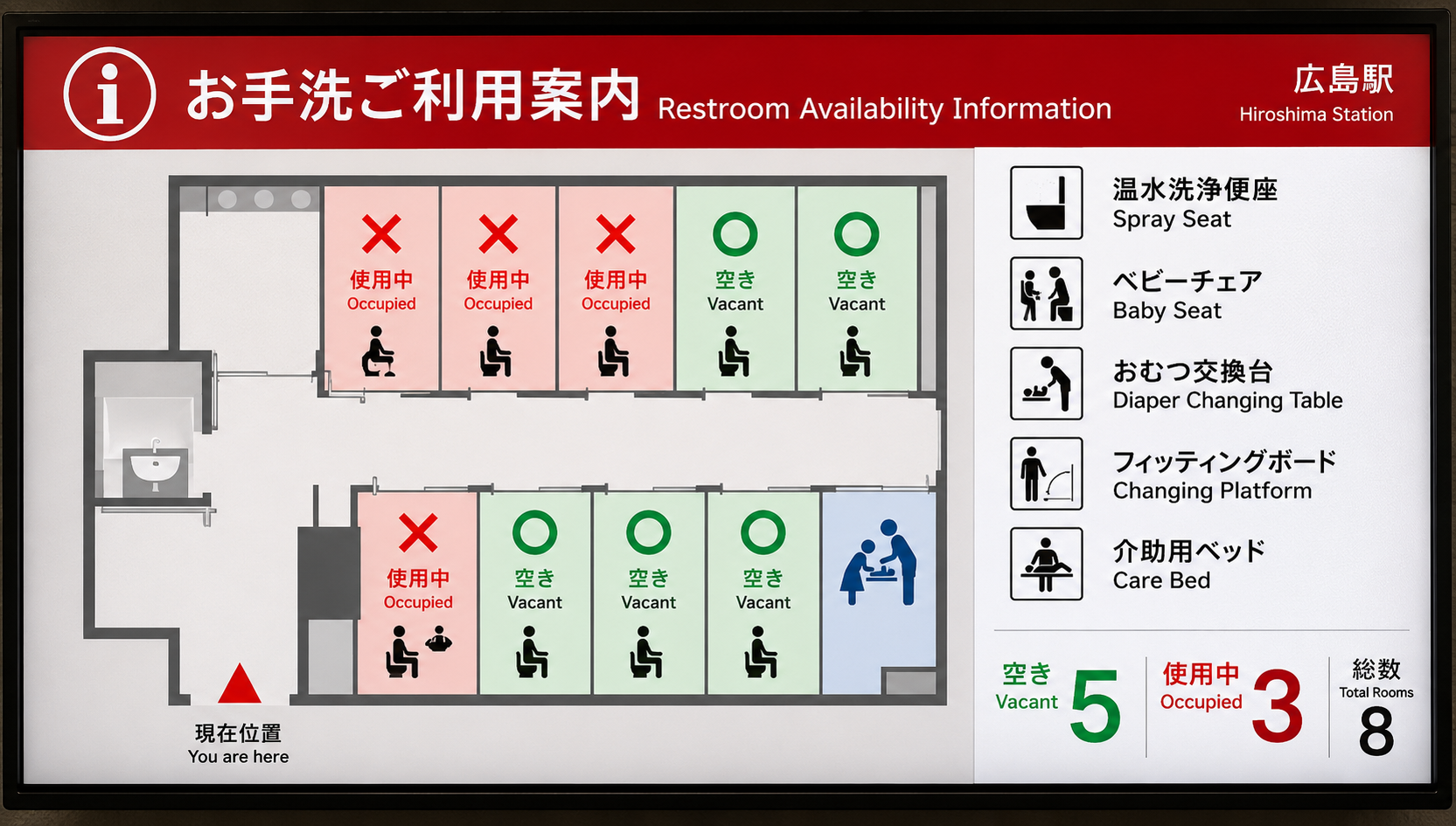
Japan’s commitment to public convenience is evident everywhere.
From the abundance of clean, well-maintained toilets to clearly marked instructions—everything is thoughtfully designed. Of course, the high-tech toilets, with their array of buttons and symbols, created moments of both confusion and amusement!
Queue systems are strictly followed, with even a dashboard showing vacant-occupied toilets! Be it metro stations, Shinkansen trains, shrines, or public spaces—clear instructions and organized systems reflect a deep respect for people’s time and comfort.
• A Thought to Take Back
If a small country can demonstrate such discipline, cleanliness, and civic sense, why not us?
The answer perhaps lies in mindset—shaped early in childhood. I am told, in Japan, children up to the age of 5 or 6 are taught values of cleanliness, responsibility, and discipline before academic rigor.
That foundation shows.
As for me, I would dearly love to return—this time at a slower pace, to absorb even more of its beauty, culture, and way of life.
Arigato gozaimasu dear Japan for your hospitality and lessons !
Back home, we switch gears to a different kind of complexity—regulatory changes. The 325th issue of Samhita brings together key updates from multiple regulators with the aim of making them easier to navigate.
For previous issues and to share your feedback: 👉 http://www.sharadasc.com/resource-center/
Karnataka Societies Registration Act, 1960
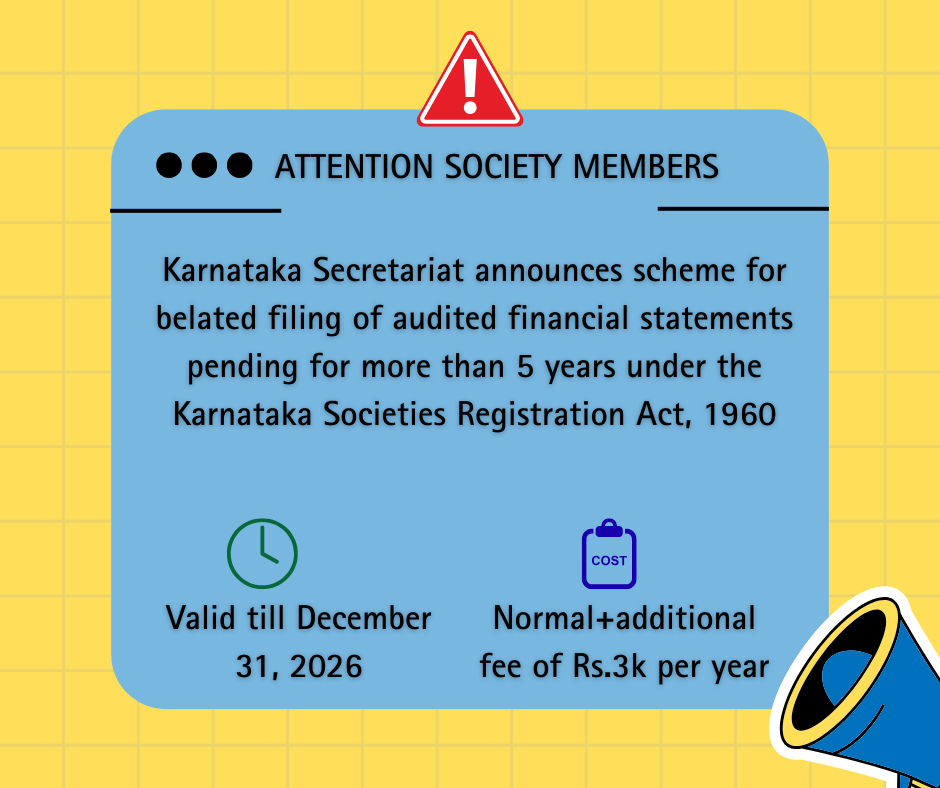
Scheme announced for filing pending annual returns under the Karnataka Societies Registration Act, 1960
A society registered under the Karnataka Societies Registration Act, 1960 is required to file its audited financial statements every year with the Registrar of Societies (RoS), within 15 days of holding its Annual General Meeting. This is required for the yearly renewal of the registration. The Karnataka Government Secretariat vide circular dated May 27, 2026 has announced a scheme under which Societies which have not filed their audited financial statements with the ROS for more than 5 years have been allowed to file the same with an additional fine of Rs. 3,000/- per year. The opportunity to file belated returns is valid till December 31, 2026.
Unlike other regulators, these circulars are difficult to trace online and through this newsletter we bring this to the attention of relevant stakeholders. It is pertinent to note that while the provisions under the Income Tax Act, 1961 may not require the financial statements of a Society to be audited if it does not breach certain threshold, the Karnataka Societies Registration Act, 1960 requires the same and the RoS strictly insists on this aspect.
Considering multiple societies function with limited awareness of the requirement to file audited financial statements with the Registrar, it may be useful for the relevant stakeholders to avail this scheme for renewing their registrations. Further, this is useful for those societies who are planning to register/list on the Social Stock Exchanges (SSE). Timely renewal can open ways for registration on the SSE.
(Open original Notification dt May 27, 2026)
(Open Translated version of the Notification)

FCRA
The Ministry of Home Affairs (MHA), vide the Foreign Contribution (Regulation) Amendment Rules, 2026, has introduced significant amendments to the Foreign Contribution (Regulation) Rules, 2011 with the objective of strengthening governance, enhancing transparency, and improving regulatory oversight over entities receiving foreign contributions. The amendments prescribe a structured framework for registration by requiring associations to specify the purposes and geographical areas for which registration is sought, introduce the concept of “key functionary” across various compliance requirements, and expand disclosure obligations in statutory forms.
The amended Rules also rationalise procedural requirements by introducing purpose-based registration, prescribing additional reporting and disclosure requirements relating to activities, social media accounts, publications, utilisation of foreign contributions, and changes in organisational details. Further, a new mechanism has been introduced for seeking subsequent instalments under prior permission, along with revised application forms and enhanced compliance requirements for existing and prospective FCRA-registered entities. These changes are aimed at promoting greater accountability, improving monitoring of foreign contributions, and ensuring effective implementation of the FCRA framework. A brief comparative analysis of existing and the new rule can be referred below.
(Open FCRA Amendment Rules, 2026)
(Open FCRA Amendment Rules, 2026 – Comparative Analysis)
Labour Laws
The Central Government, vide notification dated 30 June 2026, has notified the Employees’ Provident Fund Scheme, 2026 under the Code on Social Security, 2020, replacing the Employees’ Provident Fund Scheme, 1952. The new Scheme consolidates and modernises the provident fund framework by aligning it with the provisions of the Code on Social Security, 2020.
Major Changes Introduced in the Employees’ Provident Fund Scheme, 2026
- Introduces a greater emphasis on digital administration, including electronic maintenance of records, online filing of returns, digital submission of claims, and electronic management of provident fund accounts.
- Prescribes a comprehensive framework governing exempted establishments, including the grant, surrender and cancellation of exemptions, together with enhanced compliance requirements.
- Streamlines provisions relating to membership, transfer of provident fund accumulations, nomination, settlement of claims, and employer obligations, providing greater procedural clarity.
- Retains the existing contribution structure of 12% of wages (10% for notified establishments), continues to permit voluntary higher employee contributions, and empowers the Central Government to temporarily modify contribution rates during a pandemic, epidemic or national disaster.
(Open Ministry of Labour and Employment Notification dt June 29, 2026)
The Central Government, vide notification dated 30 June 2026, has notified the Employees’ Pension Scheme, 2026 under the Code on Social Security, 2020, replacing the Employees’ Pension Scheme, 1995. The new Scheme substantially retains the existing pension framework while aligning its provisions with the Code on Social Security, 2020 and introducing a modernised framework for administration, membership, pension entitlement, and digital compliance.
The Scheme continues to provide pension benefits, including superannuation pension, early pension, disablement pension, widow/widower pension, children’s pension, orphan pension, and nominee pension, while retaining the existing funding mechanism under which the employer contributes 8.33% of wages towards the Pension Fund, supplemented by the Central Government’s contribution.
Major Changes Introduced in the Employees’ Pension Scheme, 2026
- Introduces a digital-first administration through electronic records, online claims and digital compliance.
- Prescribes a comprehensive framework for exempted establishments, including grant, surrender and cancellation of exemptions.
- Streamlines provisions relating to membership, pensionable service, nomination and claim settlement.
- Retains the existing pension benefits and funding structure, ensuring continuity while modernising the administrative framework.
(Open Ministry of Labour and Employment Notification dt June 29, 2026)
MCA Updates
The Ministry of Corporate Affairs (MCA), vide its notification dated June 1, 2026, has amended the Companies (Registered Valuers and Valuation) Rules, 2017 with the objective of strengthening the regulatory framework for Registered Valuer Organizations (RVOs). As per the amendment, RVOs are now required to maintain a minimum paid-up share capital of Rs. 25 lakh and must be registered under Section 25 of the Companies Act, 1956 or Section 8 of the Companies Act, 2013. Further, such organizations are required to operate solely with the objective of regulating valuers of specified asset classes and must adopt byelaws in accordance with the requirements specified in Annexure – III. To facilitate a smooth transition, existing RVOs that do not meet the minimum capital threshold have been granted time until March 31, 2028, to comply with the revised provisions.
The Ministry of Corporate Affairs (MCA), vide General Circular No. 02/2026 dated June 19, 2026, has provided a one-time relaxation for filing Form DPT-3 (Return of Deposits) for the financial year 2025–26. While the statutory due date for filing Form DPT-3 remains June 30, 2026, companies will be permitted to file the form up to July 31, 2026, without payment of any additional filing fees.
The relaxation has been granted in view of the capacity enhancement and restoration activities at the MCA Data Centre following the fire incident on June 5, 2026, which affected the functioning of the MCA portal. The circular provides temporary relief to companies by waiving the additional filing fees for delayed submissions during the extended period, while ensuring continuity of compliance.
As part of the important updates issued on June 20, 2026, the Ministry of Corporate Affairs (MCA) introduced relief measures in response to the data centre disruption caused by the fire incident on June 5, 2026. The validity of approved name reservations and resubmission deadlines falling between June 21 and June 30, 2026, has been automatically extended up to July 10, 2026. Further, in cases where such timelines expired between June 5 and June 20, 2026, stakeholders have been allowed to seek extensions by raising requests with the MCA Helpdesk on or before June 30, 2026, subject to verification and continued availability conditions. Additionally, e-forms that were cancelled due to non-resubmission during the affected period may be reopened upon request, enabling stakeholders to complete their filings within the extended timeline. These measures aim to ease compliance challenges and ensure continuity of regulatory filings during the disruption period.
RBI Updates
The Reserve Bank of India (RBI) has notified the Foreign Exchange Management (Cross Border Merger) (Amendment) Regulations, 2026, effective from May 29, 2026. The amendment introduces the term “Competent Authority” to replace references to the National Company Law Tribunal (NCLT) across various provisions of the regulations. “Competent Authority” has been defined as any authority empowered under the Companies Act, 2013 or the rules made thereunder to approve a scheme of merger or amalgamation.
The amendment is primarily aimed at aligning the FEMA framework governing cross-border mergers with the evolving approval mechanisms under the Companies Act. By replacing the specific reference to the NCLT with the broader term “Competent Authority”, the regulations now accommodate merger schemes approved by other authorised authorities, such as Regional Directors in eligible cases. The change provides greater regulatory clarity and ensures consistency between FEMA and company law provisions relating to mergers and amalgamations.
RBI through A.P. (DIR Series) Circular No. 11 dated June 5, 2026, has introduced significant relaxations in the regulatory framework governing investments by Foreign Portfolio Investors (FPIs) in Government Securities. With the objective of enhancing ease of investment and improving market accessibility, the RBI has withdrawn the requirement for FPIs investing under the General Route to comply with the short-term investment limit, security-wise limit, and concentration limit. These changes are expected to provide greater operational flexibility and encourage increased foreign participation in the Indian government securities market.
The RBI has also merged the existing ‘general’ and ‘long-term’ investment sub-categories into a single investment limit for Central Government Securities and State Government Securities. Additionally, the scope of the Fully Accessible Route (FAR) has been expanded by designating all new issuances of 15-year, 30-year and 40-year Government Securities, as well as specified Sovereign Green Bonds across multiple tenors, as eligible securities under the FAR framework. Certain existing Government Securities have also been included within the FAR category. These measures are aimed at simplifying the investment regime, broadening investment opportunities for FPIs, and deepening the Indian debt market.
RBI has notified the Foreign Exchange Management (Mode of Payment and Reporting of Non-Debt Instruments) (Amendment) Regulations, 2026, effective from June 13, 2026. The amendments primarily streamline the mode of payment, remittance, and reporting requirements applicable to investments made by Non-Resident Indians (NRIs), Overseas Citizens of India (OCIs), and other individual persons resident outside India. The revised framework clarifies the permissible funding sources for investments made on a repatriation basis and introduces the concept of a designated repatriable rupee account to be used exclusively for such investments.
The amendments also provide greater clarity regarding investments in equity shares of Indian companies listed on International Exchanges under Schedule XI. Detailed provisions have been introduced governing the mode of payment for subscription and purchase of such shares, including payment through foreign currency accounts maintained by Indian companies and repatriable foreign currency or rupee accounts maintained by investors. Further, the reporting framework has been updated by revising the reporting requirements under Form LEC (IFI) for transactions involving individual foreign investors, including NRIs and OCIs, on Indian stock exchanges. These changes are aimed at enhancing regulatory clarity, facilitating cross-border investments, and aligning reporting requirements with evolving investment structures. The master direction of Foreign Investments has been updated to this extent.
RBI, through A.P. (DIR Series) Circular No. 14 dated June 15, 2026, has operationalised the liberalised Foreign Portfolio Investment (FPI) regime introduced under Schedule III of the Foreign Exchange Management (Non-Debt Instruments) Rules, 2019. Pursuant to the recent amendments, investment in equity instruments of listed Indian companies through recognised stock exchanges is now permitted for all individual persons resident outside India, whereas such investments were previously restricted to Non-Resident Indians (NRIs) and Overseas Citizens of India (OCIs). The liberalisation is intended to broaden the investor base and facilitate greater foreign participation in India’s capital markets.
To facilitate these investments, Authorised Dealer Category-I banks have been permitted to open repatriable INR accounts for eligible individual foreign investors and will be required to monitor investment limits and reporting requirements in the same manner as currently applicable to NRI and OCI investments. The circular also clarifies that any reclassification of investments from Foreign Portfolio Investment (FPI) to Foreign Direct Investment (FDI), upon breach of prescribed limits or otherwise, shall be undertaken in accordance with the framework prescribed by the RBI. These measures are expected to simplify investment procedures, enhance market accessibility, and support increased foreign investment inflows into Indian listed companies.
The RBI has issued the Reserve Bank of India (Non-Banking Financial Companies – Registration, Exemptions and Framework for Scale Based Regulation) Second Amendment Directions, 2026, effective June 24, 2026. The amendments seek to simplify the methodology for identifying Non-Banking Financial Companies (NBFCs) that fall within the Upper Layer (NBFC-UL) under the Scale-Based Regulatory Framework. The revised framework provides that NBFCs having an asset size of ₹1,00,000 crore or more, based on the latest audited financial statements, shall constitute the Upper Layer. The earlier methodology involving additional parametric assessment criteria has been removed, thereby bringing greater clarity and predictability to the classification process.
The amendments also provide that the criteria for identification of NBFCs in the Upper Layer will be reviewed periodically, while the asset-size threshold will be reviewed once every three years. Further, a new provision has been introduced for NBFCs that are group entities of Scheduled Commercial Banks, requiring such entities to comply with the applicable provisions governing banks undertaking financial services where similar activities are conducted by both the bank and its NBFC group entity. These changes are aimed at streamlining regulatory oversight, reducing complexity in NBFC classification, and ensuring consistency in the regulation of bank-led financial groups. The master direction of Reserve Bank of India (Non-Banking Financial Companies – Registration, Exemptions and Framework for Scale Based Regulation) Directions, 2025 is updated to this extent.
SEBI Updates
To provide flexibility and clarity in the winding up process of Alternative Investment Funds (AIFs), Securities and Exchange Board of India (SEBI) has issued a circular permitting retention of proceeds for specified liabilities and introducing an ‘Inoperative Fund’ framework to manage pending obligations while ensuring transparency and investor protection. Key highlights are as below:
- Applicability
Circular applies to AIFs and erstwhile Venture Capital Funds (VCFs).
- Introduction of ‘Inoperative Fund’ status
AIFs may be classified as ‘Inoperative Funds’ upon application to SEBI, particularly where they have retained proceeds for pending liabilities or are awaiting resolution of claims, and intend to surrender registration. - Conditions for Inoperative Funds
– Retained amounts must be invested only in permitted liquid instruments as per AIF Regulations.
– Cannot launch new schemes
– Cannot charge management fees
– Must continue reporting to SEBI and investors until closure of liabilities and distribution of retained funds
- Retention of proceeds beyond fund life permitted
AIFs may retain liquidation proceeds even after the liquidation/dissolution period (“permissible fund life”) under specified conditions. - Allowed grounds for retention: Retention is permitted if:
– There is demonstrable litigation or regulatory/tax demand (including notices, summons, or show-cause communications)
– There are anticipated liabilities, subject to approval from ≥75% of investors (by value). AIFs must disclose amount and duration of retention when seeking investor consent for anticipated liabilities.
– Funds are required for residual winding up operational expenses, with proper supporting documentation. - Cap on retention for operational expenses
Retention for winding up related expenses is time bound (up to 3 years)
NSE, through its circular dated June 19, 2026, has expanded the single filing system by enabling API based integration for disclosure filings under SEBI (LODR) Regulations. Listed entities may initially submit disclosures in PDF format, which will be treated as compliance, but are required to subsequently file the same in XBRL format within 24 hours. The circular also introduces new XBRL utilities and expands the scope of events covered under the system, while merging certain existing utilities for streamlined reporting. Additionally, filings will be made available in XBRL format to enhance accessibility and standardisation of disclosures.
IBBI Updates
The Insolvency and Bankruptcy Board of India (IBBI) vide notification dated June 01, 2026 has amended the Insolvency and Bankruptcy Board of India (Information Utilities) Regulations, 2017. A key change introduced by the amendment is the removal of all prescribed forms contained in the Schedule, and the substitution thereof stating that the information shall be submitted in “such format as notified by the Board through circular.
A new clause under Regulation 2(1)(lb) has been inserted after the existing Regulation 2(1)(la) to define “information of dispute,” which refers to the status of authentication of default issued in such format as may be notified by the Board through circular.
Further, an explanation has been inserted after Regulation 2(2) to clarify that, unless the context otherwise requires, any reference to the term “debtor” shall include a “corporate debtor.”
Regulation 15(3), which provides for matters to be specified in the bye-laws, has been amended to insert clause (iv) after the existing Regulation 15(3)(ba)(iii), requiring the issuance of “information of dispute.”
Regulation 21(2)(c)(iii) has been amended to provide that where the postal or e-mail address of the debtor is not available with the repository or through MCA, CERSAI or any other statutory registry, the information of default or reminder shall be delivered at the address submitted in such format as notified by the Board through circular—
(A) by a financial creditor, which is a financial institution as defined in clause (14) of section 3 of the Code; and
(B) by any other creditor, in respect of a debtor other than a corporate debtor as defined under section 3(8) of the Code.
IBBI vide notification dated June 01, 2026 has amended the definition of “Service Provider” under Regulation 2(1)(i) of IBBI (Grievance and Complaint Handling Procedure) (Amendment) Regulations, 2017. The amended provision now states that “Service Provider” shall have the same meaning as assigned to it in clause (31A) of section 3 of the Code which defines “Service Provider” as “Service provider” means an insolvency professional, an insolvency professional agency, an information utility, a registered valuer, and such other persons as may be notified by the Central Government, who are registered with the Board, for rendering services in relation to insolvency and bankruptcy processes under the Code. Earlier, the regulation contained a specific definition of “Service Provider,” which provided that it “means an insolvency professional agency, an insolvency professional, an insolvency professional entity or an information utility.”
Under Regulation 3, which provides for the filing of grievance and complaint, Regulation 3(3) has been amended to state that a stakeholder who wishes to file a complaint shall do so with the Board in such format as may be notified by the Board, instead of the earlier prescribed Form A.
IBBI has notified the Insolvency Resolution Process for Corporate Persons (Third Amendment) Regulations, 2026, introducing a series of measures aimed at improving the efficiency, transparency, and effectiveness of the Corporate Insolvency Resolution Process (CIRP). The amendments enhance disclosure requirements for operational creditors and corporate applicants, strengthen information-sharing obligations, and streamline procedural aspects relating to claim verification, withdrawal of applications, and approval of resolution plans.
The revised framework also places greater emphasis on stakeholder coordination and value maximization by facilitating the transfer of guarantor assets, introducing provisions for dissolution and restoration of CIRP in specific circumstances, and reducing timelines for key milestones. These changes are expected to improve the quality of information available to stakeholders, accelerate resolution processes, and reinforce the objective of achieving timely and effective resolution of stressed assets. Highlights of the Regulation may be referred below.
(Open IBBI notification dt June 1, 2026)
(Open Highlights of the Insolvency Resolution Process for Corporate Persons (Third Amendment) Regulations, 2026)
IBBI has notified the Insolvency and Bankruptcy Board of India (Liquidation Process) (Fourth Amendment) Regulations, 2026, introducing substantial changes to the liquidation framework under the Insolvency and Bankruptcy Code, 2016. The amendments seek to expedite liquidation proceedings, strengthen governance mechanisms, and ensure greater accountability in the conduct of liquidation processes.
A key highlight of the amendments is the enhanced role of the Committee of Creditors (CoC), which now exercises greater control over critical decisions such as appointment and replacement of liquidators, engagement of professionals, sale of assets, compromise and arrangement proposals, and extension of liquidation timelines. The amendments also shorten several procedural timelines, introduce stricter reporting requirements, and reduce the overall liquidation period to 180 days. Collectively, these reforms are intended to facilitate faster realization and distribution of assets, improve stakeholder confidence, and promote a more efficient liquidation ecosystem. Highlights of the Regulation may be referred below.
(Open IBBI notification dt June 1, 2026)
(Open Highlights of the Insolvency and Bankruptcy Board of India (Liquidation Process) (Fourth Amendment) Regulations, 2026)
IBBI has notified the Insolvency and Bankruptcy Board of India (Voluntary Liquidation Process) (Second Amendment) Regulations, 2026, effective from June 1, 2026. The amendments are aimed at enhancing transparency, streamlining procedural requirements, and aligning the voluntary liquidation framework with recent changes introduced across other insolvency regulations. A significant change is the replacement of prescribed statutory forms with forms to be notified by the IBBI through circulars, providing greater flexibility and facilitating quicker regulatory updates.
The amendments also introduce a new framework for submission and updation of stakeholder claims, requiring claims to be filed within the timeline specified in the public announcement and mandating stakeholders to update claims whenever any recovery is received from any source. Further, liquidators are now required to provide written reasons for rejection of claims and communicate their decision on admission or rejection within seven days, thereby strengthening transparency and stakeholder communication.
Another notable development is the introduction of provisions relating to the termination of voluntary liquidation proceedings under Section 59 of the Insolvency and Bankruptcy Code. The new regulations prescribe the conditions, disclosures, reporting requirements, and consequences of termination, ensuring that such termination does not adversely affect stakeholder interests and is not used to perpetrate fraud. The amendments also rationalize the schedules under the regulations by renumbering the existing schedules and removing redundant references.
IBBI vide notification dated June 01, 2026 has amended the Insolvency and Bankruptcy Board of India (Insolvency Resolution Process for Personal Guarantors to Corporate Debtors) Regulations, 2019 to insert Regulation 6A – Statement of Assets.
Regulation 6A(1) states that while submitting an application for initiating the insolvency resolution process to the Adjudicating Authority, the debtor or creditor, as the case may be, shall submit a complete and true statement of all assets including but not limited to the following, along with supporting evidence:
- Cash & Bank deposit
- Business Interest and Commercial Assets
- Investments (Domestic and overseas)
- Immovable property
- Retirement and Provident fund assets
- Digital Assets
- Intellectual property and Intangible assets
- Valuable Movable Assets
- Agricultural assets and livestock
- Receivables and Advances
- Claims and contingent assets
- ESOPs and Beneficial owner interests
Provided that the creditor shall file information relating to the assets of the individual to the extent available with him.
Regulation 6A(2) states that the following shall be mandatorily included in the statement of assets:
- assets owned directly or indirectly, whether in the name of the individual or otherwise
- assets held individually or jointly with any other person
- assets held in a fiduciary capacity, including as trustee, guardian, executor, or partner;
- assets held through beneficial ownership structures, including through nominees, trusts, partnerships, companies, Hindu Undivided Families, or any other arrangement conferring beneficial interest or control; and
- any asset over which the individual exercises control, influence, or derives economic benefit, irrespective of legal title.
Further, Regulation 11A has also been inserted for providing details on facilitation of transfer of assets.
Regulation 11A(1) provides that where the debtor is a personal guarantor undergoing an insolvency resolution process, the Resolution Professional (RP) of such debtor shall coordinate with the RP of the corporate debtor in respect of whom such guarantee has been given, regarding transfer of assets in the Corporate Insolvency Resolution Process (CIRP) of the corporate debtor in respect of whom such guarantee has been given for the purposes of section 28A which deals with transfer of assets in the cases where a personal guarantee is involved.
Regulation 11A(2) states that for the purpose of Section 28A, the RP shall obtain approval from the meeting of creditors of the debtor who has given the personal guarantee for transfer of assets in the CIRP of the corporate debtor in respect of whom such guarantee has been given.
Regulation 11A(3) states that where approval is granted by the meeting of creditors permitting the transfer, the RP of the debtor shall ensure that the proposed transfer is appropriately disclosed in the report under section 106 and section 112 (Report by RP).
Further, a key change introduced by the amendment is the removal of all prescribed forms contained in the Schedule, and the substitution thereof stating that the information shall be submitted in “such format as notified by the Board through circular.”
IBBI vide notification dated June 01, 2026 has amended the Insolvency and Bankruptcy Board of India (Bankruptcy Process for Personal Guarantors to Corporate Debtors) Regulations, 2019 by inserting Regulation 20A – Facilitation of transfer of assets.
Regulation 20A(1) provides that where the debtor is a personal guarantor undergoing an bankruptcy process, the bankruptcy trustee of such debtor shall coordinate with the Resolution Professional (RP) of the corporate debtor in respect of whom such guarantee has been given, regarding transfer of assets in the Corporate Insolvency Resolution Process (CIRP) of the corporate debtor in respect of whom such guarantee has been given for the purposes of section 28A which deals with transfer of assets in the cases where a personal guarantee is involved.
Regulation 20A(2) states that for the purpose of Section 28A, the bankruptcy trustee shall obtain approval from the meeting of creditors of the debtor who has given the personal guarantee for transfer of assets in the CIRP of the corporate debtor in respect of whom such guarantee has been given.
Regulation 20A(3) states that where approval is granted by the meeting of creditors permitting the transfer, the bankruptcy trustee of the debtor shall ensure that the proposed transfer is appropriately disclosed in the report under regulation 7 and section 155. (Submission and verification of claim and Estate of Bankrupt)
Further, a key change introduced by the amendment is the removal of all prescribed forms contained in the Schedule, and the substitution thereof stating that the information shall be submitted in “such format as notified by the Board through circular.”
IBBI vide notification dated June 01, 2026 has amended the Insolvency and Bankruptcy Board of India (Pre-Packaged Insolvency Resolution Process) Regulations 2021. A key change introduced by the amendment is the removal of all prescribed forms contained in the Schedule, and the substitution thereof stating that the information shall be submitted in “such format as notified by the Board.”
Regulation 18 has been substituted to comprehensively specify the information and documents required to be submitted by a corporate applicant when filing for initiation of the pre-packaged insolvency resolution process.
The corporate applicant shall submit the following along with the application:––
(1) a copy of the declaration made by the majority of the directors or partners, as the case may be, in such format as notified by the Board;
(2) a copy of the declaration, special resolution or resolution, as the case may be, for initiating pre-packaged insolvency resolution process in terms of section 54A;
(3) proof of approval from financial creditors, not being related parties, representing not less than fifty-one per cent in value of the financial debt;
(4) details of insolvency professional including:
(a) the written consent of the proposed resolution professional in such format as notified by the Board;
(b) the report of the resolution professional referred to in clause (a) of sub-section (1) of section 54B of the Code, prepared in such format as notified by the Board.
(5) audited financial statements of the corporate debtor for the last two financial years;
(6) provisional financial statements for the current financial year made up to the date of the declaration by the directors or partners, as the case may be; and
(7) submission made by authorised representatives in such format as notified by the Board.
IBBI Vide notification dated June 08, 2026 has amended the Regulation 16 of Insolvency and Bankruptcy Board of India (Insolvency Resolution Process for Corporate Persons) Regulations, 2016 which deals with committee of Operational Creditors.
Regulation 16(2)(a) now has been amended to read as “eighteen largest unrelated operational creditors by value”. Regulation 16(2) sets out the composition of the committee. Earlier the Committee consisted of eighteen largest operational creditors by value along with other prescribed members.
However, with the insertion of the term “unrelated,” only unrelated operational creditors shall form part of the committee, thereby reducing the possibility of conflict of interest and ensuring independence in the committee’s functioning and decision making.
Further, a proviso has been inserted after Regulation 16(2)(a) stating that where the number of such unrelated operational creditors is less than eighteen, all such unrelated operational creditors shall form part of the committee.
Regulation 16E has been inserted after the existing Regulation 16D to provide assistance to the Committee of Creditors in cases the creditors other than scheduled banks or public financial institutions hold significant voting share i.e more than 66% of the voting share in the committee. In such situations, the Resolution Professional is required to invite the five largest unrelated operational creditors, including the three largest authorities to whom statutory dues are owed, based on the value of admitted claims, to attend the committee meetings as observers without any voting rights. The Resolution Professional shall also record their observations, if any, in the minutes of the committee meetings.
The earlier Regulation 31B provided that the insolvency professional shall place in each meeting of the committee, the operational status of the corporate debtor and shall seek its approval for all costs, which are part of insolvency resolution process costs. However, now the Regulation 31B has been substituted and amended to provide detailed requirement on seeking Approval of committee for insolvency resolution process costs.
Regulation 31B(1) provides that all insolvency resolution process costs incurred till the first meeting of the committee, along with the justification for incurring such costs, shall be placed by the resolution professional for the approval of the committee at its first meeting.
Regulation 31B(2) requires the resolution professional to prepare a Going Concern Assessment Report which shall include details pertaining to —
(a) estimated income, expenditure and cash flows arising from continuation of operations;
(b) details of working capital requirements, if any; and
(c) material risks of value erosion arising from continuation or suspension of operations.
Regulation 31B(c) requires the resolution professional to place the Going Concern Assessment Report prepared under sub-regulation (2) at the first meeting of the committee and based on such Going Concern Assessment Report, the committee shall decide whether the operations of the corporate debtor shall be continued and, if so, the scope and duration of such operations.
Regulation 31B(4) states that all insolvency resolution process costs after the first meeting of committee shall be incurred only with the prior approval of the committee.
Regulation 31B(5) provides that the resolution professional shall, at each meeting of the committee after the first meeting, place before it certain details relating to insolvency resolution process costs to be incurred. These include:
(a) statements of estimated income, expenditure, and cash flows for the period up to the next meeting;
(b) seeking approval for the insolvency resolution process costs proposed to be incurred until the next meeting; and
(c) a statement comparing the actual insolvency resolution process costs incurred with the cost estimates approved by the committee in the previous meeting.
Regulation 39(3) has now been amended to require the Committee of Creditors (CoC) to record its deliberations and rationale on—
(i) the feasibility and viability of each resolution plan;
(ii) the expected realisable value to creditors as compared with the fair value and liquidation value determined under Regulation 35; and
(iii) the adequacy of market discovery undertaken during the corporate insolvency resolution process, including, where applicable, the use of a challenge mechanism or re-invitation of plans.
Earlier, the provision required the CoC to record its deliberations only on the feasibility and viability of each resolution plan.
ESG Updates
The Science Based Targets initiative (SBTi) has released Corporate Net-Zero Standard Version 2.0, a major update to its flagship framework for corporate climate action. The revised standard expands the tools available to companies for setting and implementing science-based climate targets while maintaining a strong focus on accountability and transparency. It introduces differentiated pathways for small and medium-sized enterprises (SMEs) and companies in lower-income countries, making net-zero target setting more accessible across diverse business contexts. Companies are now expected to report annually on progress, identify and disclose barriers to implementation, and continuously strengthen their climate targets through periodic improvement cycles.
The new standard also reflects a more practical approach to climate target delivery by recognizing real-world implementation challenges. It allows greater flexibility in addressing hard-to-abate emissions, including the use of certain environmental attributes and carbon-removal measures under defined conditions, while emphasizing that companies must first pursue emissions reductions within their operations and value chains. The updated standard is intended to support more effective climate action and improve the credibility and delivery of corporate net-zero commitments.
Apple has announced an initial investment of ₹100 crore (approximately US$10.5 million) to support the development of more than 150 MW of new renewable energy capacity in India through its partnership with renewable energy developer CleanMax. The initiative is part of Apple’s broader environmental strategy and is expected to generate enough clean energy to power approximately 150,000 Indian households annually. The investment is aimed at expanding renewable energy infrastructure and accelerating the adoption of clean energy across Apple’s growing supply chain footprint in India, supporting the company’s goal of achieving carbon neutrality across its operations, supply chain, and product lifecycle by 2030.
Beyond renewable energy, Apple has also announced initiatives focused on plastic waste reduction and green entrepreneurship in India. In collaboration with WWF-India, the company will support recycling and waste management projects designed to improve material recovery and reduce plastic leakage into the environment. Apple is also partnering with Acumen to provide grants, mentorship, and technical support to early-stage enterprises working in areas such as waste management, circular economy solutions, regenerative agriculture, and sustainable livelihoods. These efforts reflect Apple’s broader approach of combining clean energy investments, resource efficiency, and innovation-driven sustainability to strengthen environmental outcomes while supporting local economic development
Tax Updates
The Income Tax Department has notified the parameters for compulsory selection of Income Tax Returns (ITRs) for complete scrutiny during FY 2026–27 in respect of returns filed for FY 2025–26.
Cases selected for compulsory scrutiny include:
CS 01 (Survey Cases): Taxpayers subjected to a Section 133A survey on or after 1 April 2024.
CS 02 (Search & Seizure): Cases involving a Section 132 search or Section 132A requisition on or after 1st April 2024.
CS 03 (Reassessment): Cases where a Section 148 notice for escaping assessment was issued.
CS 04 (Exemption Denials): Trusts/Institutions (ITR-7) claiming exemptions despite cancelled or denied registrations.
CS 05 (Large Recurring Additions): Cases involving additions exceeding ₹50 lakh (Metro) or ₹20 lakh (Non-Metro), where such additions have been upheld in favour of the Revenue in earlier years.
CS 06 (Evasion Intelligence): Returns identified based on specific information received from law enforcement agencies, the Investigation Wing, or significant mismatches in Annual Information Statement (AIS) data.
The Central Government has notified amendments to Schedule IV of the Income-tax Act, 2025, effective retrospectively from 1 April 2026, in line with the commencement of the new Income-tax Act, 2025.
Key Changes:
- Amends Schedule IV of the Act (adding entries 13D and 13E) to grant a 100% tax exemption to specified global funds.
- Eligible Entities: Limited to registered Foreign Institutional Investors (FIIs) and the Bank for International Settlements (BIS).
- Tax Relief: Removes the previous 20% withholding tax on interest and 12.5% long-term capital gains tax on Indian Government Securities (G-Secs).
- Scope Restriction: Applies strictly to sovereign debt bonds; does not cover equity shares, domestic citizens, or NRIs.
Key Condition: Eligible entities must furnish the prescribed disclosures and information to the Central Board of Direct Taxes (CBDT) to avail the exemption.
GST Updates
GSTN has issued Advisory extending the implementation timeline of two important changes in the E-Way Bill system. The changes, which were originally scheduled to become effective from 15th June 2026, have now been deferred to 1st August 2026 following representations from trade and industry regarding system readiness.
Key Highlights:
- Capture of Ship-To GSTIN will become mandatory in cases where Bill-to and Ship-to parties are different and an e-Way Bill is required to be generated.
- The facility for voluntary closure of e-Way Bills has also been deferred and will now be implemented from 1st August 2026.
The Central Board of Indirect Taxes and Customs (CBIC) has issued a circular clarifying the jurisdictional treatment of GST proceedings where a taxpayer changes its Principal Place of Business, resulting in migration to another GST jurisdiction.
Key Points:
- Any proceedings, notices, audits or orders initiated by the earlier jurisdiction before the migration shall remain valid.
- After the change in jurisdiction, the earlier jurisdiction cannot initiate any fresh proceedings.
- The new jurisdiction shall assume responsibility for all subsequent actions, including completion of pending proceedings, implementation of orders and conduct of appellate proceedings.
- The circular reiterates that jurisdiction is determined based on the date on which the action is initiated.
The Government has extended the last date for filing appeals and applications before the GST Appellate Tribunal (GSTAT) to 31st July 2026.
Key Points:
- This extension applies to old orders — those communicated before 1st May 2026 (for appeals) or passed before 1st February 2026 (for applications).
- For recent orders (communicated/passed on or after the above dates), the normal time limit of 3 months or 6 months as the case maybe will apply.
- This is a one-time relief for cases where the appeal deadline had already expired or was about to expire.
Quote of the day
"When a nation's values become everyday habits, visitors return home with far more than photographs—they return with lessons."
Disclaimer: The contents of this Newsletter are only a summary and has not dealt with any issue in detail. Any action taken or proposed to be taken must be in consultation with professionals and not merely based on the articles / news updates. S. C. Sharada & Associates disclaims all liability on action taken without professional advice.